Showing posts with label Iron Profile. Show all posts

Friday, September 19, 2014

Iron Profile: Cat 983B Track-Type Loader

 
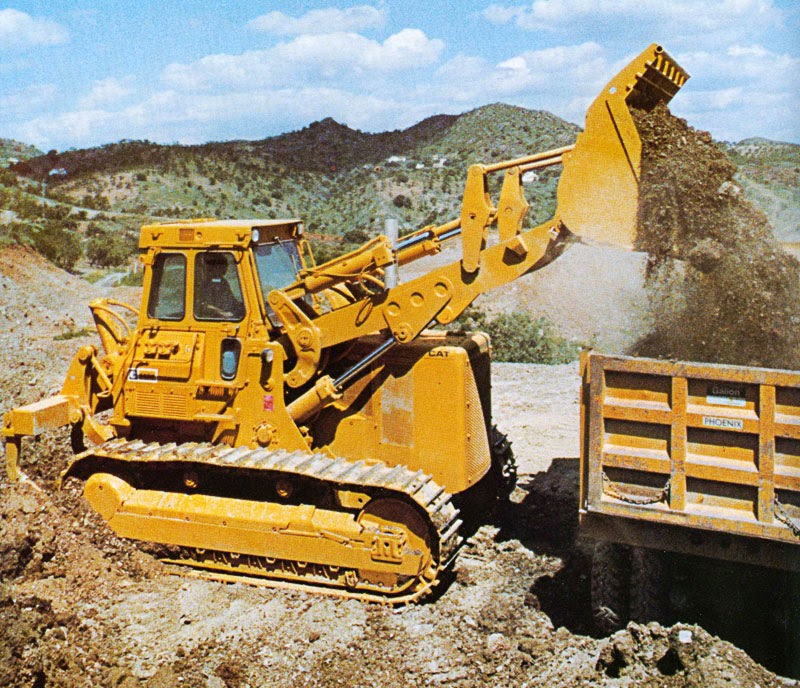
In 1978 the largest track loader that had yet been made by the Caterpillar company was introduced: the Cat 983B Track-Type Loader.

The lineage from which 983B loader came is an interesting one. The Trackson Company of Milwaukee, Wisconsin had produced an inovative cable-driven shovel lifting system for digging or excavating, and sold them for mounting to Caterpillar tractors beginning in 1936. Caterpillar quickly recognized the value these devices added and began offering the "Trackson Shovel option" in 1937 with thier Caterpillar Thirty.


Over the years, Trackson continued its relationship with Caterpillar, developing cable shovels to be fitted on specially modified tractors with longer trackframes. During the 1940s these machines started to become known as "Traxcavators". In 1951 Caterpillar Company purchased Trackson and continued the production of the Traxcavator line under its own roof, creating many variations of this powerful and versatile style of loader in later years.


The 983B Track-Type Loader followed and improved upon the already impressive 983 loader, as well as abandoning the well-respected Traxcavator name. Producing 275 flywheel horsepower from its six-cylinder, 893 cubic-inch, 3406 diesel engine, the 983B featured pedal steering, freeing the operator's hands for the transmission and loader controls. An automatic bucket control system allowed the 4-1/2 cubic-yard bucket to rise to a pre-set dumping height and return to a pre-set digging angle for fast cycle times.

Equipment operators who had the opportunity to run it, still recall the 983B's power with awe. One such gentleman recounted to us how he was able to put the bucket teeth down and peel back a roadway, the asphalt pushing into a huge roll in the bucket like a layer of sod, and then lifting the whole of it to dump over the side of a haul truck. Now that's powerful loader.

Wednesday, December 18, 2013

Iron Profile: Marion 7200 Walking Dragline

The first Marion walking dragline ever built was still in operation more than 50 years later.


The 7200 Walking Dragline from Marion has long been revered for its durable and consistent performance, and with good reason. The first one ever made (ostensibly just a prototype) worked over 50 years, 6 days a week, for multiple shifts, which puts its productivity near 160,000 hours.

The original 7200 built in 1939 was equipped with a 100-foot boom and a 5-cubic yard bucket. Over the next 20 years many were sold, mostly with 6 and 7-cubic yard buckets. In addition to the electric machine utilizing Ward-Leonard drive, some were diesel driven. In the diesel configuration, they were equipped with 2 engines: a 300 horsepower Fairbanks-Morse 31A which was used to power the hoist and drag drums through clutches and brakes, and a 144 horsepower Cummins engine to drive a DC generator for the electric swing motors.

Primarily used in coal mining applications, the Marion 7000 series draglines were some of the most effective stripping shovels ever made. The 7200 was their second best seller with 57 units built between 1939 and 1957. They were also used for more generic material handling purposes, such as loading rail cars. Frequently this machine would be used to remove large quantities of sand and gravel overburden from the top of coal deposits.

There is a project underway to preserve the last known 7200 that hasn’t yet been scrapped. Let's hope it finds a suitable retirement for its historic life.

Friday, November 8, 2013

Iron Profile: Cat 914G Wheel Loader


When Caterpillar introduced the 914G wheel loader in 1995, it did much more than just update an older machine. The 914G represented a totally new concept in wheel loaders at the time and was one of the first Cat machines designed using virtual reality computer technology, shortening the production from seven years down to three. So significant was the design that Caterpillar had it patented. Program manager Jeff Griffith said at the time, “from the ground up, the 914G is a new machine, the only thing that stayed the same was the color.”

Key features of the 914G’s design included a hydrostatic drive transmission, spacious cab with 67% more glass than previous designs for enhanced visibility, and a Cat 3054T diesel engine transversely mounted at the rear of the machine to provide better balance and easier access to the engine compartment.

The 914G was available in a standard wheel loader configuration or as an integrated tool carrier, the IT14G, featuring an integrated quick coupler that allowed easy changes from a bucket to forks or one of many other attachments that would increase productivity.
 
The most interesting aspects of the 914G was the product development. Design engineers used 3-dimensional software models of the machine's cab interior to evaluate multiple designs without having to build prototypes, saving significant time and money. With the aid of “virtual dirt” the engineers were better able to simulate ripping, digging, and dumping in different soil types, and design the most efficient configurations for the machine.


In 1997, we introduced the 914G as our first 1:48 scale model. The size was ideal for our collectors because it allowed plenty of detail while fitting nicely on a shelf.

“We chose to produce a model of the 914G because it is the first wheel loader in Cat’s new G series,” said CCM’s former president, Bob Peterson. “We recognized Caterpillar felt the design of the 914G was important enough to warrant a patent, so our goal was to create a model that was equally unique.”

The exceptional quality of the 914G model so impressed Caterpillar that the first ten replicas produced were given to executives in the company as commemorative gifts.
 
With detail as impressive as its true-life counterpart, our all-brass 914G model had windshield wipers, “cornerless” windows, rubber tires, working hydraulic cylinders, muffler, turn signals, an AC compressor and drive belt, and authentic Caterpillar markings. The model’s detail showcased the creature comforts of the ergonomically-designed 914G cab, complete down to the miniature rearview mirrors. All was was fully articulated and hand-assembled from more than 250 parts.

Only 300 of these models were made. Each came with certificate of authenticity and were individually serial numbered. Originally priced at $359.95, the rarity and quality have allowed them to hold their value over time.


Friday, October 4, 2013

Iron Profile: The Caterpillar D8 Through History


Few pieces of equipment are more representative of the history of Caterpillar than their D8 track-type tractors. This family of machines has been an integral part of the Caterpillar line from its farm and agricultural roots to the construction and mining equipment powerhouse it is today.


First introduced in 1935 as the RD8, this tractor was immediately popular for its balance of size and power. As the years went by, a multitude of attachments and modifications would be made available from both Caterpillar and allied equipment manufacturers. This included products such as cable-operated bulldozer blades, canopies, push blocks, pipelayer cranes, and towed scrapers. Each year saw successive improvements in design, features and horsepower.

As the construction industry grew hungry for machines to build America, the D8 tractor catered to their desires with reliable performance. Military versions of the D8 found their way to the theaters of World War II and provided critical support for the construction needs of American forces.

HISTORIC D8 HIGHLIGHTS:

The RD8 debuts in 1935. Based on a Caterpillar Seventy-Five with a little more horsepower, it wouldn't be long before it was updated with the D13000 six-cylinder diesel engine, pushing it to 95 drawbar horsepower and 108 belt horsepower. Its operating weight was 50,025 lbs.


By the 1950s the D8 would have style changes to the body and the ever-reliable D13000's horsepower was increased 150 at the drawbar. With thousands of units in the field, the D8 dropped the "R" in its designation and was a top seller in Caterpillar's stable.


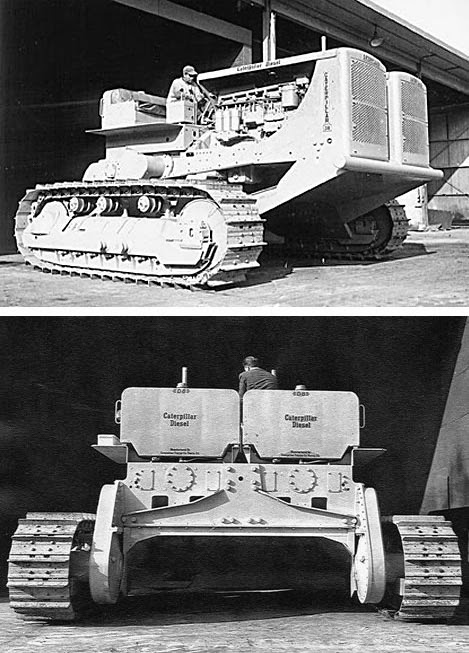
Before the larger D9 was created, any demands for a more powerful tractor were sometimes met with unique solutions. The Twin D8 above was one of only three developed by Peterson Tractor's Special Equipment Services between 1949 and 1951. Tested with a variety of attachments, one would eventually be equipped with a custom 22-foot wide bulldozer blade. Peterson engineers would directly influence Caterpillar Research more than any other outside source at the time.


The D8H in 1969, shown here with a standard hydraulic bulldozer blade.  Some of the many other attachments available were front and rear push blocks allowing multiple D8s to push equipment together end-to-end, and a three-shank ripper for breaking up rock on a job site.


A D8K Track-Type Tractor, circa 1974. The machine now boasted 300 flywheel horsepower provided by the Cat D342 turbocharged, fuel-injected, six-cylinder diesel engine. Improvements had been made all around; the frame made thicker for more durability, a higher load handling transmission, and a larger radiator for more efficient cooling. This unit is shown with optional ROPS (Roll Over Protection System) Modular Cab, heavy-duty radiator guard, track roller guards, hydraulic control, 8S Bulldozer and multishank ripper.


In 1981 Caterpillar introduced a completely redesigned tractor with the D8L. The most obvious of these improvements was the elevated final drives and sprockets. This system, first introduced In the D10 tractor, allowed the final drives, clutches and brakes to be free of the loads and stress common to the old design. The ROPS and cab were now standard, and the D8L was now the most powerful in the D8 lineage with the 335 flywheel horsepower 3408 turbocharged, V-8 diesel engine.


Caterpillar's current version is the D8T, released in 2004. It features all of the most modern engineering that makes it one of the best bulldozers in the world. The engine is the Cat 15 ACERT six-cylinder diesel, producing a maximum 364 horsepower. Operator controls are ergonomic, responsive, and precise. The powertrain benefits from a century of Caterpillar experience, and its differential steering and power shift transmission allow fine control of an impressive amount of power.


Over the decades of the D8's lifetime, innovations in its design have always been toward optimized operator comfort and maximized production capability. The D8 was quickly accepted as the industry standard for large earth moving applications, and their durability and continuing popularity is easily verified by the number of these tractors still in use today in every type of environment. What the future holds for this series of tractors can only be guessed, but we are be sure the D8 will maintain legendary status.

Wednesday, July 24, 2013

Iron Profile: Caterpillar Seventy Track-Type Tractor


In 1934 Caterpillar began selling the Seventy Tractor, the largest its gas-powered tractors, which were being replaced by the newer diesel machines becoming more popular at the time. This precursor to modern track-type tractors has a classic appearance, and is historically significant for being the last large gas-powered Caterpillar tractor made.

In the years emerging from the Great Depression, many municipalities and private contractors used the Seventy in the construction of roads. It was prized for its ability to multi-task as the wide swinging drawbar could pull a variety of equipment. The Seventy also received use in agricultural applications and helped mechanize America’s farms on a larger scale than the Cat Ten did four years earlier. The Seventy was also a favorite of the timber industry, as it could safely and efficiently pull equipment and logs over rough terrain.

The engines were four-cycle, water-cooled, with four cylinders, capable of running 700 rpm when governed at full load, at maximum drawbar pull it was capable of 420 rpm. The overall length was nearly 12’, height was 7.5’, width was almost 9’, with ground clearance over 10”. Other specs of interest are: a 31,000 pound shipping weight, 90 gallon fuel tank, and the steering was controlled by slow speed, heavy duty, dry multiple disc clutch and contracting brake.


The Depression years of the 1930s were difficult for all industries, and Caterpillar was no exception. Even though the Seventy had been developed from years of tractor-making experience, sales totaled only 266 machines over the four years of its production. Despite being one of the more rare of the track-type tractors, the Seventy lived on in the diesel powered Seventy-five tractor and later innovations that would propel Caterpillar from agricultural products into a leader of earthmoving equipment.

Friday, July 19, 2013

Iron Profile: Cat 953C Track Loader


The Cat 953C track loader entered the market in 1995 and has proven a big success judging by the estimated 8000 that were produced around globe up until 2005.

The 953C had a wide variety of uses, including backfilling, stripping top soil, landscape contouring, excavating, and truck loading. Ground Engaging Tools (G.E.T.), different buckets, and other assorted attachments allow a multitude of configurations, helping the 953C maximize its performance on any job.


The standard bucket capacity is almost 2.5 cubic yards.  Although not as impressive in size as many of the other machines produced by Caterpillar, it still weighs a respectable 16 tons.  The Cat 3116 engine is placed at the rear to provide more balance, and moves the machine with 121 flywheel horsepower. Emissions and fuel consumption have been kept much lower in comparison to its predecessors. The hydrostatic drive eliminates the need for manual shifting and allows the 953C to be considerably faster and more responsive than the 951C.


At the time they were produced, the cab was second to none in operator comfort: sound-proof, rollover protected, and air pressurized to keep out dust and moisture. The electronic monitoring system gives the driver quick visual status updates on data related to critical machine functions, including three warning levels in case of a failure.

The 953C was a showcase for the benefits of track loaders, including the high floatation and traction provided by tracks, as well as the load handling of multiple bucket options. Even today, this machine continues to work hard for its devoted owners.

Friday, May 10, 2013

Iron Profile: Manitowoc M-250 Crawler Crane


Beginning initially as a shipbuilding and repair company, Manitowoc has been manufacturing a variety of cranes of since the mid-1920s. In 1992 they introduced the M-250 lattice boom crawler crane, which was all hydraulic and could be self-erected in as little as three hours. The rated loading capacity was 300 tons.

Lattice boom cranes of this size can be used on a number of different projects: building bridges, stadiums, malls, refineries, and virtually any large construction or industrial application. They can certainly be used in manufacturing applications as well, but their sheer size makes them less desirable in small spaces. Many are utilized in a dragline capacity, as was the M-250, as well as used in dredging efforts using a clamshell bucket system.

The M-250’s rotating bed featured Manitowoc’s FACT (Fast Aligning Connection Technology) system for quick attachment of the rotating module to the carbody, it used alignment devices, power-activated pins, and the H-FACT quick coupler to assist with crane assembly and disassembly. The operator’s station was fully enclosed and insulated, equipped with a sliding door and large safety glass windows on all sides, including the roof. The engine was a Cummins N14-C450 diesel rated for 450 horsepower at 2,100 RPM. The engine came standard with a 120V heater, ether starting aid, transmission disconnect clutch, and hydraulic oil cooler. Manitowoc’s Electronically Processed Independent Control (EPIC) system provided micro-processor-driven control logic, pump control, onboard diagnostics, and service information.


The carbody connected the rotating bed to the crawlers. The steel rotating module mounted to the single-piece carbody via a large (9’8”) diameter turntable bearing. When assembled, the crawlers were 30’9” long with reinforced steel frames, the treads were 4 feet wide, and there were low-maintenance intermediate rollers. Each of the two crawlers was powered independently by two variable-displacement hydraulic motors and a planetary-and-spur gear reduction that drove the chain to the crawler. The crawlers had the additional ability to counter-rotate which allowed superior mobility in confined areas.

Friday, April 12, 2013

Iron Profile: Northwest 190D Dragline

 
The 190D dragline manufactured by Northwest Engineering (NWE) of Green Bay, Wisconsin, was the machine many companies have turned to for clearing overburden from valuable deposits such as coal and iron ore. This configuration included a Hendrix five-yard bucket to move loose material efficiently, allow other workers to access the rich deposits. The 190D also came with a clamshell option for precise loading of the commodities onto trucks, trains, or barges and it was more suitable for deep vertical applications.  Many of NWE’s cranes were extensively used in the construction of highways and railways during the middle of the 20th century.

The cab was excellent when it came to comfort and productivity. The operator utilized finger-tip controls, and was well isolated from exterior noise. An adjustable bucket seat decreased vibration and allowed longer working time. Tinted windows reduced light and heat, while air conditioning was an available option.


The dragline came standard with heavy-duty swing clutches, which allowed the boom and bucket to move smoothly, rather than the jerking motion that is inherent in other clutches. Heat dissipation is one of the keys to continuous clutch operation, and the 190D design excelled at this because the driving elements pulled air through the clutch by constantly rotating.

The 190D had many other impressive features. Its independent boom hoist used its own uniform pressure disc clutches and operated separate of all other machine functions. It also came standard with a 60’ alloy steel boom for light weight and maximum strength. The revolving fairlead increased cable life with two fully-housed roller bearings to keep dirt out of their lubrication. Additional 190D options included a third drum equipped with its own air actuated pressure clutch, and power load lowering allowing even the heaviest loads to be moved into a specific position.

Friday, March 29, 2013

Iron Profile: Cat D11R


In March of 1996, Caterpillar introduced the D11R which was equipped with a 3508B EUI—turbocharged and aftercooled—increasing output from the 770 horsepower of the D11N model to 850 horsepower. The new machine also meet new EPA emission standards, but by and large the performance metrics were comparable to the D11N, which had dominated the size class with 70% of sales the decade prior.

The other improvements to Caterpillar’s largest track type bulldozer occurred primarily in the cab. An Electric Clutch Brake (ECB) steering system with Finger Tip Control (FTC) put into a single panel allowed the operator to control steering, machine direction, and gear selection all with the left hand. The blade and ripper controls remained on the right hand side of the cab. This increase in comfort and ease of operation improved performance, reduced human error, and shortened job time

There were also noteworthy improvements made to the brakes, including thicker plates and disks which provided higher torque capacity and increased service life. The oil cooling valve controls 75 gallons per minute, representing an almost 80% increase. These improvements were key, as it takes a lot to slow and stop a 108-ton piece of equipment.


Several months after the release of the D11R, Caterpillar unveiled the D11R CD (Carrydozer). The CD featured a taller, deeper curved blade that would allow pushing of more material over greater distances. The machine also had other improvements to help the increased load, such as a strengthened structure, rock guards and deflector shields to protect lift and tilt cylinders from spillover. The unique blade also enabled the tractor to operate on steeper slopes.

Friday, March 8, 2013

Iron Profile: Caterpillar 631E and 637E Scrapers


Introduced in the 1980s, the Caterpillar 631E wheeled tractor-scraper was the latest iteration of Caterpillar’s highly successful scraper line. By combining speed and mobility with substantial earth-moving prowess, these units handled large capacities of topsoil more effectively than bulldozers. Its most significant benefit was the capability to move loads over distances at speed. Soon after the release of the 631E, Caterpillar released the 637E which had a second motor situated behind the debris bin. This gave additional power, traction, and a slight increase in speed over its predecessor, although the capacity was largely the same.


The 631E came standard with a four-stroke 3408 turbocharged V-8 engine which generated 450 flywheel horsepower and propelled the fully loaded scraper up to 30 mph. This included a direct-injection CAT fuel system with individual, adjustment-free injection pumps, variable injection timing and water jacket aftercooling. A 24-volt electric starting system with an ether starting aid was included for use in harsh temperatures. An electric monitoring system oversaw critical functions of its operation.

Tractor and scraper together weighed 95,000 pounds when empty, but over 171,000 pounds when its 75,000 (~31 cubic yds) capacity load was maxed. The scraper could cut as deep as 17.2” with a blade width of nearly 11.5’ giving it substantial ability to remove and relocate large amounts of top soil. They were frequently utilized to level and/or flatten areas that were turned into housing developments, parking lots, and shopping malls.


Caterpillar released the 637E which had the benefit of  a second motor situated behind the debris bin. This gave additional power, traction, and a slight increase in speed although the scraper's capacity was largely the same.


It isn’t unusual to see more than one 631E or 637E working in the same area at a time. While they can be run single file, they are more often seen side-by-side (offset a little bit) working in a loop, scraping off dirt in one area and depositing it elsewhere as needed. The scrapers popularity and quality is well evidenced thirty years later as these machines can still be found turning mountains into mole hills.

Tuesday, January 22, 2013

Iron Profile: Caterpillar 5230 ME and FS


Officially launched in the summer of 1994, the 5230 Front Shovel (FS) was and remains one of largest earth-movers produced during Caterpillar’s considerable history. Nearly twice the size of the 5130, it weighs in at an impressive 347 tons. The bucket capacity is 22.2 cubic yards and is large enough to load the 150-ton-capcity 785 mining truck in 4 to 5 passes, which was the original intent of the 5230 model. These massive machines are powered by a Cat 3516 EUI quad-turbocharged and aftercooled diesel engine.

A year later, the 5230 Mass Excavator (ME) rolled off the production line and brought with it a 20.3 cubic-yard general purpose bucket, but it also had an optional 31.4 cubic-yard bucket specifically designed for coal mining. To date, the 5230 ME has sold just as well in the market place as the shovel version and compares favorably to the large excavators of other manufacturers.


Standard to both editions of the 5230 are the Automatic Engine Speed Control (AESC) and the Vital Information Management System (VIMS). The AESC is a fantastic cost saving feature and it benefits the environment as well, through a reduction in fuel consumption. If the hydraulic controls remain unactuated for even a few seconds the engine speed automatically drops by 400 rpm. The VIMS system keeps the operator in the cab continuously updated on critical data relevant to the machine’s performance.


Due to its size, the early editions of the 5230 had to be shipped in eleven individual modules out of the plant in Decatur, Illinois, and assembled on site by the customer.

For nearly twenty years Caterpillar's 5230 has rightfully earned its mammoth reputation.

SPECIFICATIONS:

Cat 3516 Engine (flywheel power) — 1470 (1095 kW)
Engine displacement — 4210 cu in (69 liters)
Fuel tank —1386 gal (5330 liters)

Front Shovel
Operating weight — 702,000 lb. (318,420 kg)
Bucket capacity — 20.2 to 22.2 yd3 (15.5 to 17.0 m3)
Mass Excavator
Operating weight — 697,980 lb. (316,600 kg)
Bucket capacity — 21.0 to 36.0 yd3 (16.0 to 27.5 m3)


Wednesday, January 16, 2013

Iron Profile: Caterpillar D9L


The D9 series of track-type tractors has been a hugely successful product line of Caterpillar for several decades running. From the prototype D9X in the mid-1950s all the way up to present day, various iterations of the D9 have been seen dominating innumerable landscapes all around the globe.
 
The D9L (first introduced in 1980, eventually replaced by the D10N in 1987) was a crawler tractor that kept the line of bulldozers going strong, and had considerably more horsepower than the T, R, and N versions. It was equipped with a Cat 3412 direct injection engine.  This unit was turbocharged with 12-cylinders which produced 460 flywheel hp. The standard edition had oil-cooled disc brakes and clutches.

 
Of particular note on this legendary machine was the raised undercarriage that lessened the strain and shock loads to the drive sprocket as it no longer sat near the ground, the first of the D9 series to feature this adaptation. Manufactured exclusively in the United States, there were multiple modifications during its brief history including a crank driven radiator fan, higher engine side guards, and pressure applied steering clutches to name a few.
The dozer blade came initially in a P version, but straight (S) and universal (U) options were made available as part of the 1985 reconfiguration.

Although the D9L was never the largest tractor at any point it was a substantial upgrade from the earlier models of the D9 series.


SPECIFICATIONS:
Cat 3412 turbocharged V-12 diesel engine (flywheel power) — 460 HP (343 kW)
Engine displacement — 1,649 cu in (27 liters)
Fuel tank —255 gal (965 liters)
Operating weight (9S Bulldozer) — 111,910 lb. (50,762 kg)

Wednesday, October 31, 2012

Iron Profile: Caterpillar 777 Off-Highway Haul Truck


Introduced by Caterpillar in 1974, the 777 became one of the company’s most popular line of off-highway haul trucks. Building on their experience with the 769B and 773 trucks, the 777 continued the successful mechanical-drive haulers into the 85 ton class. This truck featured the 870-flywheel-horsepower D348, V-12 diesel engine, and low weight-to-horsepower ratio. With the seven-speed planetary transmission, this power was put to good use, typically in mining and large earthmoving projects.


The 777 had a newly designed front end, ROPS cab and engine deck. This allowed much easier in-frame servicing by technicians, and was so successful it continues to be the basic design used today. The ride over rough quarry roads was made smooth by four huge oil-pneumatic suspension cylinders. The two front cylinders acted as steering kingpins for a short turning radius in tight loading spots. The 777 could make a clearance turning circle in 88 feet.


The Cat 777 body had the same familiar features that proved so reliable and durable on the 769B and 773 trucks: dual-sloped dump bed designed for retaining heaped loads up steep inclines, wrap-around ribs for added strength, steel corner castings and rolled steel toprail sections to reinforce critical stress areas, and a low loading height. The ten box-sectioned ribs also had the unique feature of funneling engine exhaust to heat the bed for easier dumping of sticky materials in cold weather.


So successful was this haul truck it found itself developed by Caterpillar into an off-highway tractor called the 776. This powerful tractor proved versatile enough to become popular in variations modified to suit a wide spectrum of needs. High-capacity dump bodies, coal haulers, and heavy equipment trailers—all have seen use.

The 777 series truck has continued over the years to its current version, the 777G, with new advances in technology refining its weight class. For almost three decades this hauler has proven itself one of Caterpillar’s most durable and successful trucks.


SPECIFICATIONS:
Horsepower, flywheel — 870 (649 kW)
Total empty weight —122,600 lb. (55,610 kg)
Loaded weight to Hp ratio (with standard options) — 336:1
Capacity, tons — 85 (77t)
Cubic yards, struck (SAE) — 47.5 (36 m3)
Cubic yards, heaped 2:1 (SAE) — 67.1 (51 m3)
Transmission — 7 range automatic power shift with 1 reverse range.
Top speed loaded — 33 MPH (53 km/h)

Tuesday, September 18, 2012

Iron Profile: Caterpillar 992C Wheel Loader


After making great strides in developing rubber-tired construction equipment throughout the 50’s and 60’s, Caterpillar created what some consider one of the finest wheel loaders ever designed. The 992C front-end loader was released to the public in 1977. The 992C surpassed the previous 992B version in nearly every way. Larger and more powerful than its predecessor, the 992C contained the new turbocharged V-12 Model 3412 diesel engine, pushing out 690 flywheel horsepower.


One of the most unique features of this loader was the newly designed lift arms with the Z-bar linkage. This configuration boosted the 992C’s capacity to an incredible 12.5 cubic yards and 37,000 pounds. Its speed had increased, as well, and it could load a 50-ton-capacity truck in just three passes.

Modern features of the 992C were the Caterpillar EMS (Electronic Monitoring System) which allowed the operator to track critical equipment systems; a sound-isolated operator’s cab, separate from the ROPS (Rollover Protection System) canopy, allowing optional climate controlled running; and high-reach loader arms for use with trucks up to 120 tons.


A significant option for the 992C was the steel-shoed “beadless” tires, which allowed the machine to work in extreme conditions such as the sharp rock surfaces in quarries. These essentially extended the loader’s range into the domain of track-driven machines.

So well designed was the 992C wheel loader that it survived virtually unchanged, other than a new 13.5 cubic yard bucket, for its entire career as Caterpillar’s big loader. Being one of the best-selling front-loaders of all time has assured the 992C’s rightful place in heavy equipment history.

Wednesday, September 5, 2012

Iron Profile: Marion 6360 Shovel "The Captain"


At the time of its creation in 1965 for the Southwestern Illinois Coal Corporation, the Marion 6360 was the world's largest mobile land machine; with ballast it weighed 28 million pounds. It required 10 months for field erection at the Captain mine near Percy in Southern Illinois. Working around the clock, seven days a week, it helped deliver approximately 150 railroad carloads of coal a day. It moved overburden 270 tons at a pass, uncovering two coal seams simultaneously at the mine.


This interior view shows the two hoist drums that were driven by eight 1,000 hp electric motors, the largest ever used in an excavator. Four 3 1/2-inch wire ropes hoisted the dipper through a two part hitch. One of eight 625 hp swing motors is in the background.

Four motor generator sets converted 14,000 volt AC power to direct current for twenty main-drive motors capable of 30,000 horsepower output. The shovel could propel itself at 1/4 mph on four pairs of crawlers. Each crawler was 45 feet long and 16 feet high. Each crawler shoe measured ten feet across and tipped the scales at 3 1/2 tons.

The operator could telephone nine other stations on the machine, talk to the ground by loudspeaker, or to other mine areas by radio. A 3-man 8-story elevator transported crewmen from the lower frame to the machinery deck and gantry structure.

There was more than a mile of wire rope in the Marion 6360. The hefty dipper measured 24 feet from teeth to door, was 18 feet wide, 24 feet high, and could hold 180 cubic yards of earth and rock.