Thursday, October 10, 2013
Memorable Model: The Marion 7200 Walking Dragline
On May 13, 1939, the very first Marion walking dragline ever built was shipped to Placer Properties in Oakland, California. Although it was originally built as a prototype, that same Model 7200 was still operating at American Aggregate Corporation's Indianapolis yard over fifty years later. In 1994 Classic Construction Models was honored to pay tribute to the legacy of that machine and the 7200s that followed it with a special limited edition of just 150 models.
Built to a precision 1:48 scale, our all brass model of the Marion 7200 Walking Dragline was carefully developed from original drawings supplied by Marion and a painstaking field survey of the actual machine. Each of the digging movements–hoist, drag, boom topping and swing–are fully functional, along with walking shoes that move in the same “up and over” motion as those on the real machine.
We delivered the model to our customers fully assembled and rigged with a perfectly scaled version of the 6-cubic yard bucket and 100’ boom that were on the original machine. This would be our only model of a walking dragline until 2009, when we made a replica of the largest ever built, the Big Muskie.
The adjustable boom had a length of 25” and the body a length of 9.5” making this an impressive looking piece on a shelf or desk. The width of the model at the outside of the shoes was 8.5” and the body was 9” tall. It weighed just over 9 pounds. These models sold originally by reservation only for $1795 each, and occasionally can be found in secondary markets today for a great deal more.
Friday, October 4, 2013
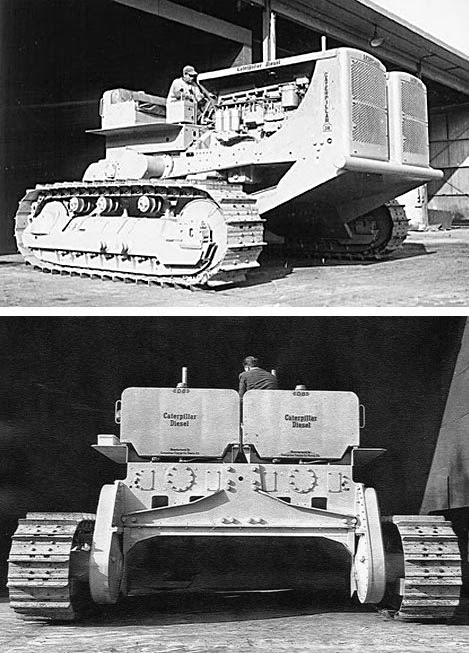
Iron Profile: The Caterpillar D8 Through History
Few pieces of equipment are more representative of the history of Caterpillar than their D8 track-type tractors. This family of machines has been an integral part of the Caterpillar line from its farm and agricultural roots to the construction and mining equipment powerhouse it is today.
First introduced in 1935 as the RD8, this tractor was immediately popular for its balance of size and power. As the years went by, a multitude of attachments and modifications would be made available from both Caterpillar and allied equipment manufacturers. This included products such as cable-operated bulldozer blades, canopies, push blocks, pipelayer cranes, and towed scrapers. Each year saw successive improvements in design, features and horsepower.
As the construction industry grew hungry for machines to build America, the D8 tractor catered to their desires with reliable performance. Military versions of the D8 found their way to the theaters of World War II and provided critical support for the construction needs of American forces.
HISTORIC D8 HIGHLIGHTS:
Over the decades of the D8's lifetime, innovations in its design have always been toward optimized operator comfort and maximized production capability. The D8 was quickly accepted as the industry standard for large earth moving applications, and their durability and continuing popularity is easily verified by the number of these tractors still in use today in every type of environment. What the future holds for this series of tractors can only be guessed, but we are be sure the D8 will maintain legendary status.
Thursday, September 19, 2013
From the Archives: CCM in the Oregonian 1993
Friday, September 13, 2013
Memorable Model: Cat 140H Motor Grader
In late 1997 we introduced our brass model of the Cat 140H Motor Grader. This was the fifth release in our 12 model series, the Caterpillar Classic Collection in 1:87 scale.
Complete with Cat markings and livery, this 140H has amazing detail for the available technology at the time and being such a small-scale replica. It includes an articulated front end, free-spinning rubber tires, and a moldboard that rotates. The operator’s cab and front axle are especially detailed, and even the side view mirrors on the operator cab rotate. The dimensions of the model were 3.9” long, 1.1” wide, and 1.4” high. All weighing just a couple ounces.
This particular model would not have been possible without extensive feedback from engineers and operators at Caterpillar. We were able to make this model so accurate because of the valuable input we received.
Only 1000 of these models were produced, and they each sold for $149.95. Individual serial numbers and certificates of authenticity assured buyers their purchase was a true collectable.
Friday, August 30, 2013
Cat 777 Haul Truck and 776 Tractor with MET-185 pre-production samples
Here are some photos to enjoy over the long weekend. Some changes will be made to these samples for production, but we are really happy with how they look so far!
Friday, August 23, 2013
Models in the house – C175-20 has arrived
We are excited to announce our model of the Cat C175-20 Genset just came in the door today. We will begin shipping them out next week. Our stock are all reserved, but you may find it at one of the fine dealers that carry our models. Check it out here on our website for more details.
In other news, pre-production samples of the Cat 777 Haul Truck and 776 Tractor with MET-185 Trailer came in today! We have been so excited to see these models, and they do not disappoint. We are working through our review and will post photos for you next week. Stay tuned!
Wednesday, August 14, 2013
CCM Behind the Scenes: Markings and Paint
Although they might seem inconsequential at first glance, the markings and paint on a scale model are like icing on a cake. When they are right, they enhance the enjoyment of the final product. When they are wrong, they can have a negative impact disproportionate to their size. At CCM we seek the most realism we can achieve in our models and that includes these tiny details. In this Behind the Scenes installment we will look at some of the challenges in this part of our process.
Model numbers, company logos, warning labels, and safety callouts—all are markings commonly seen on the real machines. For modern equipment, the placement and specifications for these are usually straightforward and easy to come by, as manufacturers such as Caterpillar have digital artwork that we can reduce to the proper scale.
![]() |
| A Cat 777 Haul Truck on location where we conducted our machine survey. Not many markings left on this one. |
Vintage machines are the real challenge. Construction and agricultural equipment sees hard use, and over the course of forty or fifty years warning labels face a life of abrasion, fading from the sun, and other abuse. If an old machine gets repainted, those factory-adhered labels are almost never re-applied. Most often it is only the machine numbers that find their way back on a fresh coat of paint. For this reason, the amount of research we have to do to find accurate references for a piece of vintage equipment can be substantial. Old brochures, antique photos, and surveys of existing machines are all necessary.
In the case of our model of the Caterpillar No.12 motor grader, we were lucky to be able to refer to our vast in-house archives of vintage product brochures and sales sheets. Cross referencing this with our machine survey and other photos, we were able to create accurate markings for a machine that is well over sixty years old.
![]() |
| We were lucky to find a rare original label on this old No.12 for reference. |
Markings are applied to the surface of our models with a process known as pad printing, often called "Tampo" printing after the leading manufacturer of the equipment. A soft silicone pad stamps a layer of paint on the model in a precise movement, as well as fine registration. This allows for a very crisp graphic that can wrap over a curved surface. Here is a link to examples of various Tampo techniques.
![]() |
| A paint and Tampo guide provided to our manufacturer for our upcoming Cat 16M Motor Grader cab interior. |
Before the markings are placed, however, the model first needs a coat of paint matched to the manufacturer's standard. Next to the company logo, there is nothing more they want to see properly executed on a scale model of their machines. Company colors are an integral part of their brand and manufacturers hold us to a very high standard for proper matches which includes their final approval for both current and vintage colors on our models.
As many enthusiasts know, Caterpillar yellow has changed over the years. The original “Hi-way Yellow” introduced in the 1930’s needed to change to meet the growing environmental requirements introduced in the 1970’s. In 1979 Caterpillar made the decision to modify the color that had been famous for over 47 years to the current Caterpillar “honey yellow”. Although the new paint color is strictly controlled, there was often some variation in the old Hiway Yellow from year to year, manufacturing locations, and paint formulations.
We hope this information is helpful and gives you a better understanding of the process we follow to create the world-class scale models our collectors treasure so highly.
Labels:
Cat,
CCM Behind the Scenes,
scale model
Subscribe to:
Posts (Atom)