Saturday, May 25, 2013

Model Announcement: Cat 16M Motor Grader in 1:48 scale


We are pleased to announce our latest 1:48 precision scale die-cast model.

The Machine:
Caterpillar considers their M Series Motor Graders to be a revolution in operational efficiency and overall productivity. The 16M is designed to help build and maintain the haul roads needed to support mining operations. From the high-visibility operator's station it is easy to see the moldboard and tires, as well as behind the machine with the rear vision camera. Grade control and machine monitoring technologies help improve grading efficiency and enhance fleet management. Load sensing, proportional hydraulics mean operators can rely on consistent power for precise, predictable implement response. The Cat C13 engine delivers 297 horsepower, and up to 337 with the VHP (Variable Horsepower) system employed at higher speeds. All this power is transferred to the road surface through the Power Shift Countershaft Transmission, with eight forward and six reverse gears designed to give a wide operating range.

The Model:
The CCM 1:48 scale die-cast model of the 16M Motor Grader captures the superb engineering of the actual machine in high detail.  As always, we have pushed to get as much functional movement in our model as possible. The moldboard, circle and hydraulic systems all able to be displayed in a realistic position. The front steering tilts to the side so that the 16M model looks as though its ready to grade miles of smooth roadway at the proper angle. A full array of fine-scale details are apparent, such as opening doors to the full operator’s cab, complete safety railings, movable seven tine rear ripper/scarifier, and a segmented midpoint to aid in steering. Accurate scale tires, lights, mirrors, and grab rails contribute to the realism. All is finished with Cat approved paint and markings.

Each model comes packaged in a collector's box and includes a signed and serial numbered spec brochure reproduction. More information will be available on the is page of our website:
ccmodels.com/caterpillar-Cat-16M.shtml

Production will be limited, so please contact us if you would like to be placed on the request list for this impressive model.

Email: sales@ccmodels.com
Phone: 503-626-6395, Monday - Friday | 8am - 5pm PT

The first rapid prototype sample at the manufacturer.
We will post better photos once it arrives in our office.

Friday, May 10, 2013

Iron Profile: Manitowoc M-250 Crawler Crane


Beginning initially as a shipbuilding and repair company, Manitowoc has been manufacturing a variety of cranes of since the mid-1920s. In 1992 they introduced the M-250 lattice boom crawler crane, which was all hydraulic and could be self-erected in as little as three hours. The rated loading capacity was 300 tons.

Lattice boom cranes of this size can be used on a number of different projects: building bridges, stadiums, malls, refineries, and virtually any large construction or industrial application. They can certainly be used in manufacturing applications as well, but their sheer size makes them less desirable in small spaces. Many are utilized in a dragline capacity, as was the M-250, as well as used in dredging efforts using a clamshell bucket system.

The M-250’s rotating bed featured Manitowoc’s FACT (Fast Aligning Connection Technology) system for quick attachment of the rotating module to the carbody, it used alignment devices, power-activated pins, and the H-FACT quick coupler to assist with crane assembly and disassembly. The operator’s station was fully enclosed and insulated, equipped with a sliding door and large safety glass windows on all sides, including the roof. The engine was a Cummins N14-C450 diesel rated for 450 horsepower at 2,100 RPM. The engine came standard with a 120V heater, ether starting aid, transmission disconnect clutch, and hydraulic oil cooler. Manitowoc’s Electronically Processed Independent Control (EPIC) system provided micro-processor-driven control logic, pump control, onboard diagnostics, and service information.


The carbody connected the rotating bed to the crawlers. The steel rotating module mounted to the single-piece carbody via a large (9’8”) diameter turntable bearing. When assembled, the crawlers were 30’9” long with reinforced steel frames, the treads were 4 feet wide, and there were low-maintenance intermediate rollers. Each of the two crawlers was powered independently by two variable-displacement hydraulic motors and a planetary-and-spur gear reduction that drove the chain to the crawler. The crawlers had the additional ability to counter-rotate which allowed superior mobility in confined areas.

Wednesday, May 1, 2013

Cat 336E Model Variations

To further clarify our upcoming 336E configurations we have included some additional information here. Initially there was not a photo of the quick coupler version because we still had some development to do on the coupler itself–which as you can see below in the short video is fully functional.

The Cat 336E Excavator With Thumb Version will have the permanently affixed hydraulic thumb. The Cat 336E Excavator With Quick Coupler Version will include two interchangeable buckets: the general purpose bucket and a 2.5-yard, wide cleanout bucket.

Cat 336E Excavator With Thumb Version

Cat 336E Excavator With Thumb Version

Cat 336E Excavator With Quick Coupler Version

Cat 336E Excavator With Quick Coupler Version


Tuesday, April 23, 2013

Model Announcement: 1:24 scale Cat 336E Excavator


We are pleased to announce our latest 1:24 precision scale die-cast model.

The Machine:
Since its introduction in the 1990s, the 300 Series family of excavators has become the industry standard in general, quarry, and heavy construction applications. The first model in the new E Series family, the 336E, meets the demands for more productivity and comfort, less fuel consumption and emissions. Hydraulic horsepower for the 336E has increased from the previous series’ output due to a high-pressure system, including pump and other improvements. This translates into the new E Series moving more material in less time. The operator's station has everything needed to meet the needs for comfort and productivity. All systems can be monitored easily on the large LCD display. 291 flywheel horsepower is provided by the proven Cat C9.3 ACERT diesel engine, featuring three different power modes: high power, standard power, and economy power. The operator can easily change between these to meet the needs for the job at hand – all to help manage and conserve fuel. An extensive range of Cat Work Tools for the 336E includes buckets, compactors, grapples, multiprocessors, thumbs, rakes, rippers, and shears. Quick couplers allow one person to change work tools in seconds for maximum performance and flexibility on a job site.

The Model:
The CCM 1:24 scale die-cast model of the 336E Excavator is an impressive piece. Working at this scale allows us to add even more highly accurate detail than usual. Hydraulic lines and connections, manifolds, bolts, engine – all are represented in stunning accuracy. Doors and access panels open like they do on the real machine allowing a great view of the full operator's cab and C9.3 ACERT power plant. Connections for the cooling, electrical, and hydraulic systems are fully detailed. Individually-linked track shoes are spring tensioned. Boom and stick have a full range of motion, echoing the real machine. The Cat paint scheme, markings and safety labels are all approved by Caterpillar. The 336E Excavator model will be available in two work tool variations: a general duty bucket version with hydraulic thumb, and a quick-coupler version with interchangeable general-duty bucket and wide-cleanout buckets.

Each model comes packaged in a collector's box and includes a signed and serial numbered spec brochure reproduction.

Production will be limited, so please contact us if you would like to be placed on the waiting list for this impressive model.

Email: sales@ccmodels.com
Phone: 503-626-6395, Monday - Friday | 8am - 5pm PT


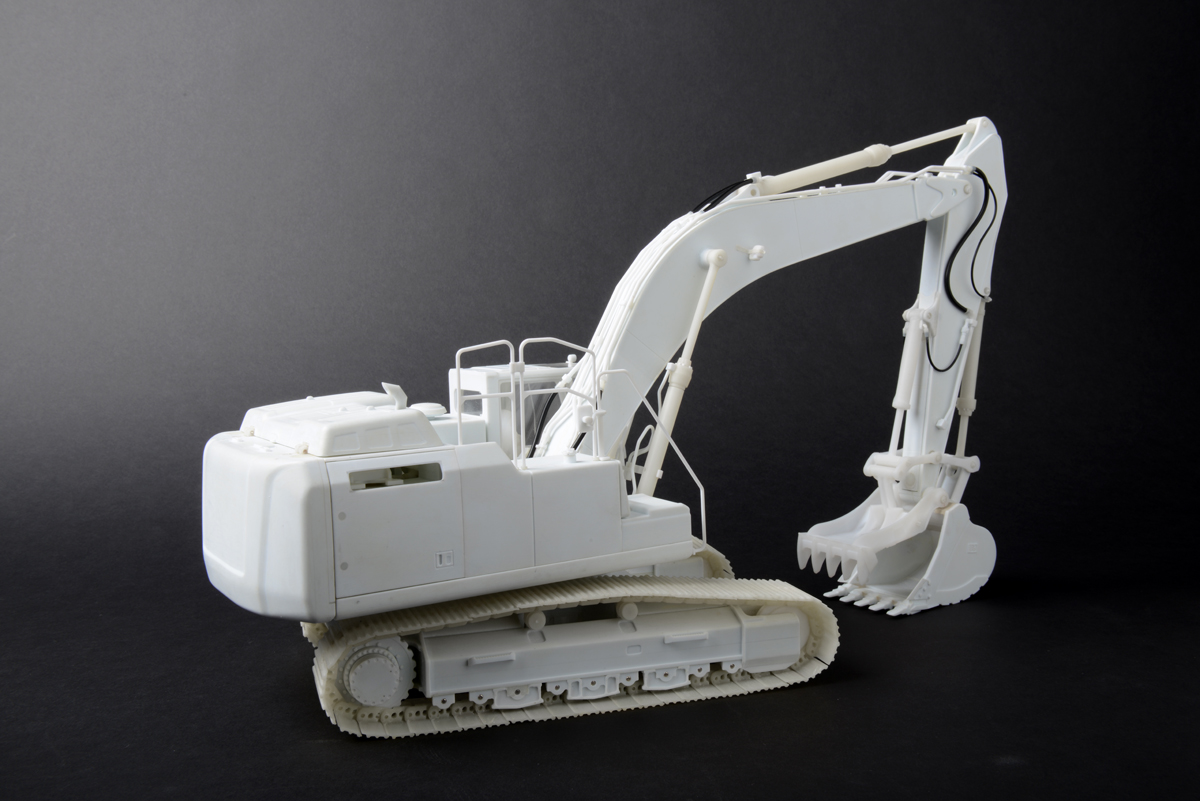
336E resin prototype front

336E resin prototype rear

336E with open doors

336E prototype shown with 1:24 scale D11R

336E prototype shown with 1:24 scale D7E

Friday, April 19, 2013

Memorable Model: Caterpillar Seventy Track-Type Tractor


In 1934 Caterpillar began selling the Caterpillar Seventy track-type tractor, the largest and last of its gas-powered tractors which were soon to be replaced by the newer, more popular diesel machines.  In the years emerging from the Great Depression, many municipalities and private contractors used the Seventy in the construction of roads. It received heavy use in agricultural circles, as well, helping mechanize America’s farms on a larger scale than the Caterpillar Ten did four years earlier. The Seventy was also a favorite of the logging industry as it could safely and efficiently pull equipment and logs over rough terrain. 

In 1996 we released the Caterpillar Seventy track-type tractor, our first 1:24 scale, brass Caterpillar model. As with all of our pieces, we spent countless hours familiarizing ourselves with the original machine to develop the model of the Caterpillar Seventy. By referencing a multitude of machine plans, photos and measurements of the real tractor, we designed the most precise model possible. The model has over 375 etched, cast or machined brass parts.  Details included individually-linked tracks, functional track tensioners, a full engine, accurate controls, and complete suspension. The final pieces were finished in a period livery of Caterpillar paint and markings.


The model was approximately 7” in length, 4” wide, and 4.5” tall. It weighed in at over 2.5 pounds of brass. Each was individually serial numbered and came with a certificate of authenticity. The cost at the time of release was $1295. Of particular note, was the size of the single production run. Caterpillar only produced 266 of the actual Seventy, so we responded in kind by only producing 266 collectable models.

Friday, April 12, 2013

Iron Profile: Northwest 190D Dragline

 
The 190D dragline manufactured by Northwest Engineering (NWE) of Green Bay, Wisconsin, was the machine many companies have turned to for clearing overburden from valuable deposits such as coal and iron ore. This configuration included a Hendrix five-yard bucket to move loose material efficiently, allow other workers to access the rich deposits. The 190D also came with a clamshell option for precise loading of the commodities onto trucks, trains, or barges and it was more suitable for deep vertical applications.  Many of NWE’s cranes were extensively used in the construction of highways and railways during the middle of the 20th century.

The cab was excellent when it came to comfort and productivity. The operator utilized finger-tip controls, and was well isolated from exterior noise. An adjustable bucket seat decreased vibration and allowed longer working time. Tinted windows reduced light and heat, while air conditioning was an available option.


The dragline came standard with heavy-duty swing clutches, which allowed the boom and bucket to move smoothly, rather than the jerking motion that is inherent in other clutches. Heat dissipation is one of the keys to continuous clutch operation, and the 190D design excelled at this because the driving elements pulled air through the clutch by constantly rotating.

The 190D had many other impressive features. Its independent boom hoist used its own uniform pressure disc clutches and operated separate of all other machine functions. It also came standard with a 60’ alloy steel boom for light weight and maximum strength. The revolving fairlead increased cable life with two fully-housed roller bearings to keep dirt out of their lubrication. Additional 190D options included a third drum equipped with its own air actuated pressure clutch, and power load lowering allowing even the heaviest loads to be moved into a specific position.

Friday, April 5, 2013

Memorable Model: Northwest 190D Dragline


In 2000 we released our 17th brass crane model. It was the 1:48 scale Northwest 190D dragline in gorgeous orange, black, and white livery. This replica of the legendary machine was made with intricate detail as the brass was etched, cast, fabricated, and assembled by hand. We think it still looks fantastic on the desks and shelves of our collectors.

The model featured several life-like elements, including: free rolling tracks, 360 degree cab rotation with a functioning cab door, accurate rigging, working fairlead, and a Hendrix 5-yard bucket.  The approximate dimensions of the model were 25” long, 5” wide, and 16” in boom height.


Each piece came with a certificate of authenticity and were individually serial numbered. The price was $1,495 and the production run in this case was only 250 models.

In 2010 we released an additional 13 units in the vintage orange and black NW paint scheme.